Skip to content
Plenthera

K2 + D3: the duo that sends calcium to your bones

For years, vitamin D3 has been known as the "sun vitamin" for strong bones. What many people don't know: D3 primarily helps your body absorb calcium from your diet, but it doesn't automatically ensure that this calcium ends up in the right place. For that, a second vitamin is needed that acts as the "traffic controller": vitamin K2. In this article, you'll read how these two vitamins work together, why they are more effective as a duo than separately, and how to choose a suitable form.
K2 + D3: het duo dat calcium naar je botten stuurt

Why K2 and D3 work together, and what exactly K2 is

Vitamin D3 and vitamin K2 each have a unique role in your body's calcium balance — and these roles complement each other perfectly. D3 ensures the absorption of calcium from your intestines into the blood. K2 then activates two specificproteins(osteocalcin and matrix-Gla-protein) that transport calcium from the blood to your bones and teeth — and keep it out of your blood vessels and soft tissues.

Without sufficient K2, a high dose of D3 could theoretically even have an unfavorable effect: more calcium enters the blood, but without K2, some of it remains circulating in the blood vessels or tissues instead of going to the bones. That's why many people who use D3 in higher doses for an extended period choose a combination product with K2.

Source:EU Register on nutrition and healthclaims (Regulation (EU) 432/2012 — officially authorised health claims).

What exactly is vitamin K2 — and why not K1?

Vitamin K consists of two main forms: K1 (phylloquinone) and K2 (menaquinone). K1 is mainly found in green leafy vegetables and primarily plays a role in blood clotting. K2 is produced by bacteria — both in fermented products (natto, some cheeses) and to a limited extent by the bacteria in our own intestines.

K1 and K2 differ in their distribution in the body: K2 remains available in the blood longer than K1 and therefore also reaches tissues outside the liver, such as bones and blood vessels. Within the K2 family, MK-7 (menaquinone-7) is considered the most stable subform, with a half-life of approximately 72 hours.

Are you not getting enough K2 from your diet?

In the Netherlands, the vast majority of the population gets very little K2 from their diet. The richest source is natto (fermented soybeans) — a traditional Japanese dish that is hardly eaten here. Other sources include raw milk cheeses (Gouda, Brie) and some egg yolk and organ meat, but the amounts are limited. For those who want certainty about an effective K2 status, supplementation is the most practical route.

Who benefits from a K2 + D3 combination?

  • People already taking higher doses of D3— from about 1000 IU per day, K2 becomes increasingly beneficial.
  • 40+ target group— from the age of 40, the risk of bone loss increases, and calcium distribution to the bones becomes more critical.
  • Women during and after menopause — declining estrogen levels accelerate bone loss; K2 + D3 + sufficient calcium is then a commonly used combination.
  • People actively concerned with their vascular health:K2 helps keep calcium in the right place.
  • Vegans and vegetarians— who get almost no K2 through their diet.

For those who only use a low maintenance dose of D3 (e.g., 400-800 IU) and have no specific risk factors, K2 as a separate supplement is less critical. But as soon as the D3 dosage becomes higher, or with an increased risk of bone loss, the interaction between K2 and D3 becomes increasingly important.

Frequently Asked Questions about K2 + D3

Which K2 + D3 form is right for you?

Choosing the right combination

There are three main routes to combine K2 and D3 — as a ready-made combination product, as a separate supplement to an existing D3 intake, or as part of a broader bone formula. Which route is best depends on your current supplement use and preference.

Capsules (combination product) 

A combination capsule with both K2 and D3 is the most practical route: one capsule per day, a fixed ratio between the two vitamins, taken with a fat-containing meal for optimal absorption. Pay attention to the K2 form (preferably choose MK-7) and the dosage — for maintenance, 75-100 micrograms of K2 per day is a common choice.

Liquid (drops) 

For those who do not want to swallow capsules, or for those who want to be able to vary the dosage, a liquid combination offers flexibility. Drops are also useful for the elderly or people with swallowing difficulties.

Bone formula (all-in-one) 

For those who want more than just K2 + D3, there are bone formulas that contain calcium, magnesium, and silicon in addition to K2 and D3. These are particularly suitable for the 40+ age group or during peri-menopause.

In the Plenthera range 

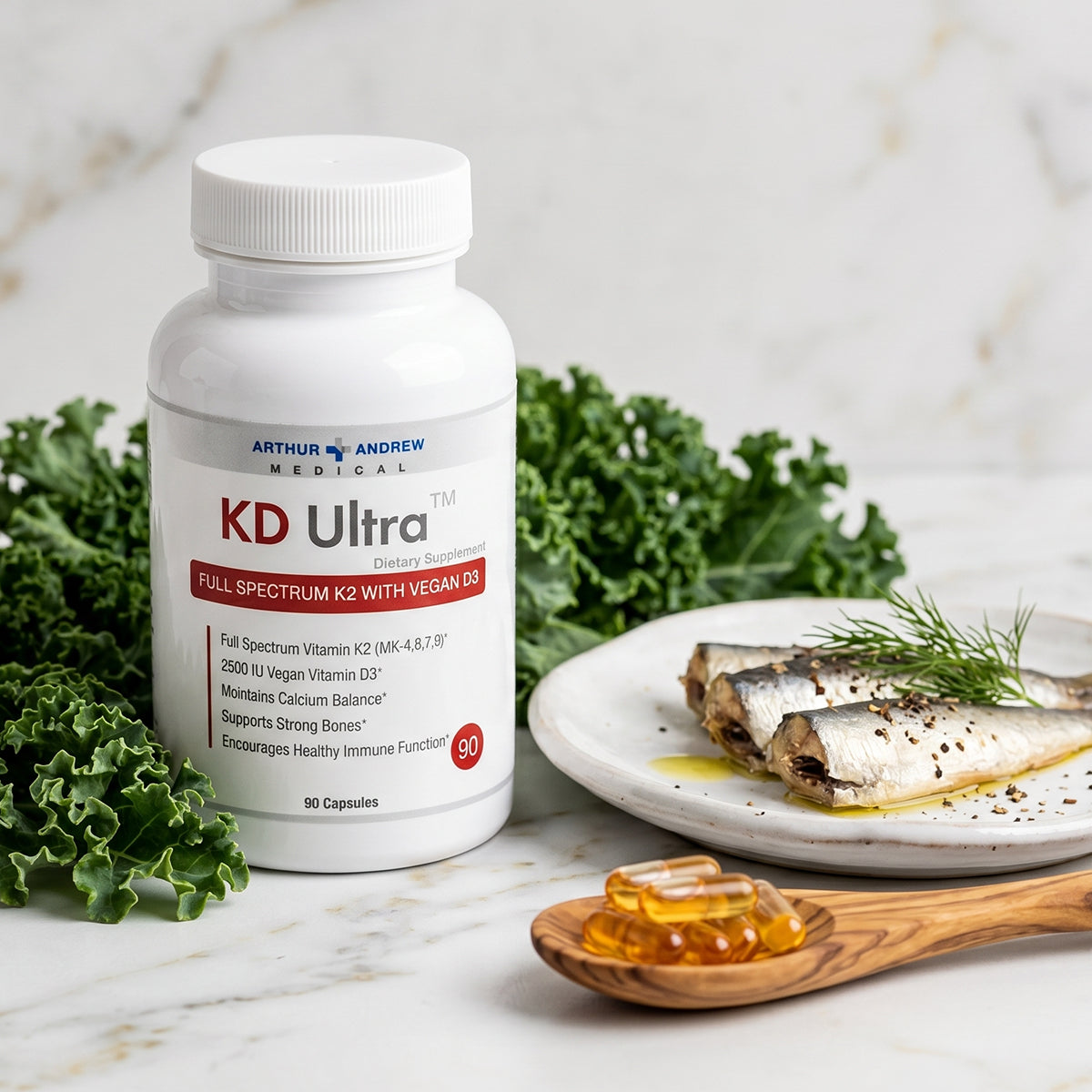
Arthur Andrew KD Ultracombines full-spectrum vitamin K2 (MK-4 + MK-7) with vegan vitamin D3 (4000 IU) in one capsule — suitable for those who combine a high D3 dosage with effective K2 supplementation. Vegan and hypoallergenic. Plenthera is the exclusive supplier of Arthur Andrew Medicalin the Netherlands and Belgium. For those who prefer a ready-made capsule with a classic ratio: Vitals Vitamin K2+D3 (60 caps, vegan). For drops fans: Trace Liquid D3+K2 (59 ml).

Disclaimer: This article is for informational purposes only and does not replace medical advice. A dietary supplement is not a substitute for a varied and balanced diet and a healthy lifestyle. If in doubt or taking medication: consult a doctor or pharmacist. Do not exceed the recommended daily dose. Keep out of reach of young children.

Previous Post Next Post