


Cognitive Blend and Adaptogens: What Nootropics and Adaptogens Are | Brain & Focus Month

Maca Powder – Organic Gelatinized – 100 g
Choose your option

L-Theanine 200 mg – from green tea – 60 Vegan Caps
Choose your option

Doctor’s Best L-Theanine – Suntheanine® – 150 mg – 90 vegetarian capsules
Choose your option

Rhodiola-LF – Rhodiolife® extract – 60 Vegan Caps
Choose your option

Ashwagandha-KSM Organic - 60 capsules
Choose your option

Choose your option

Extra Strong Ginkgo - 360 V-Caps
Choose your option

Choose your option

AHCC® 500mg - 60 caps
Choose your option

AHCC® – 180 Capsules (500mg)
Choose your option
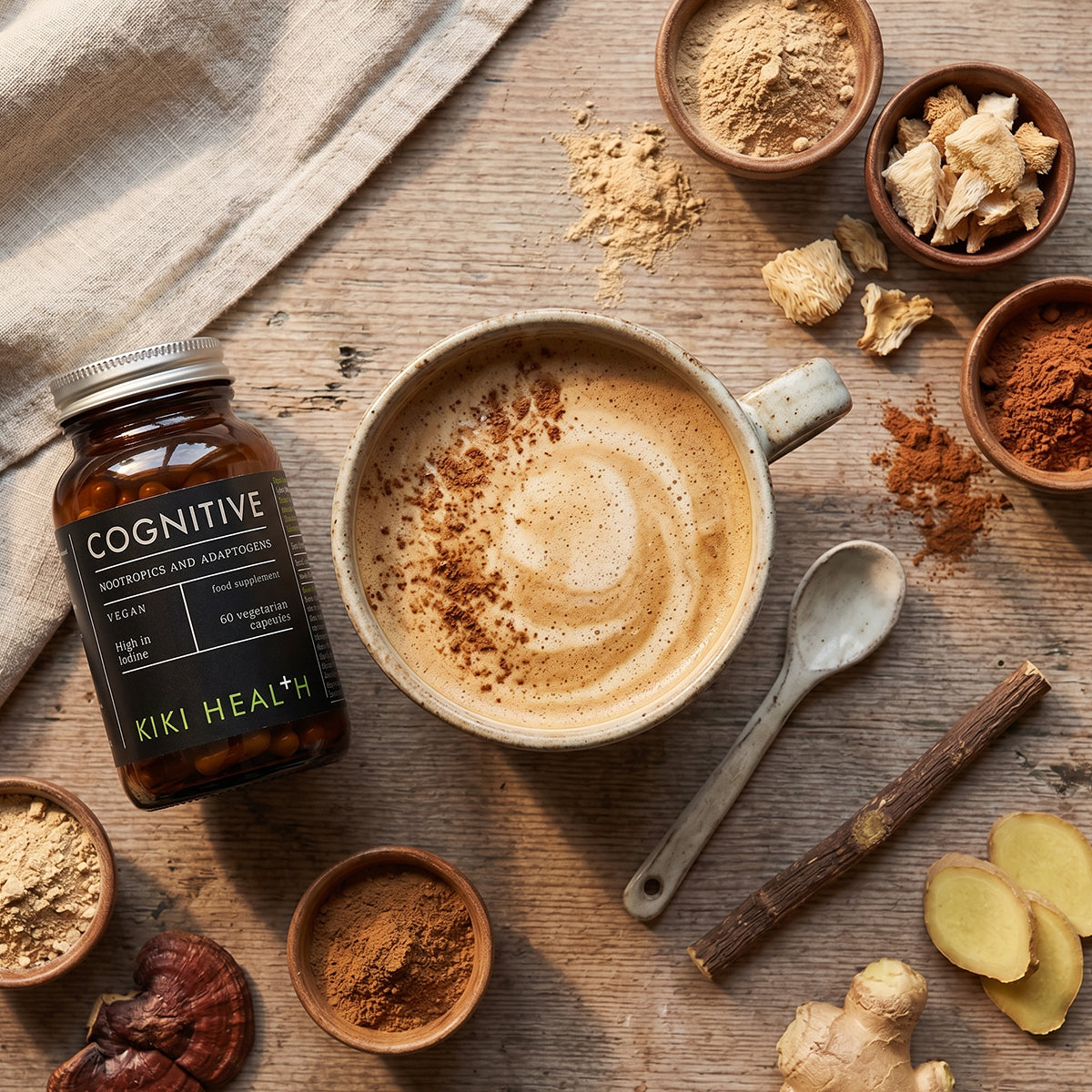
Nootropics vs. Adaptogens: The Difference and the Best-Known Nootropics
Nootropics: the category and well-known examples
The term "nootropics" is used as a collective name for various substances discussed in the context of mental performance. There are no recognized EFSA health claims for these substances. Commonly mentioned examples include Ginkgo, L-theanine, B vitamins, and the mushroom (Lion's Mane).
Adaptogens: origin and background
Adaptogensare originally herbs from Ayurvedic, Chinese, and Russian traditional medicine. It is a collective term used in these traditions. There are no recognized EFSA health claims for these herbs.
The distinction traditionally made is that nootropics are placed in the context of cognition, while adaptogens are placed in the context of stress. In practice, the two categories are often discussed and combined. For both groups, recognized EFSA health claims are lacking.
The best-known nootropics in supplements
L-theanine
An amino acid naturally found in green tea. L-theanine is often used in combination with caffeine and is a popular ingredient in so-called focus stacks.
Lion's Mane
A mushroom containing hericenones and erinacines. Lion's Mane is often included in nootropic stacks.
Ginkgo biloba
One of the oldest herbal plants discussed as a nootropic — used for millennia in Chinese medicine. There is no recognized EFSA health claim for Ginkgo. Doctor's Best offers an Extra Strength variant with 360 capsules.
B vitamins
Especially B6, B9 (folic acid), and B12contribute to normal psychological function and the reduction of tiredness and fatigue. A good B-complexis a nootropic base for many people (see PlantforceVegan B-Complex — private label).
The most well-known adaptogens and ready-made blends
Ashwagandha (Withania somnifera)
Comes from the Ayurvedic tradition, where it has been used traditionally; nowadays it is available in standardized forms (such as KSM-66®). Forashwagandhathere is no recognized EFSA health claim.
Rhodiola rosea
A mountain herb from Scandinavia and Siberia, traditionally used in the context of fatigue - especially known for use in extreme climatic conditions. Important nuance: Rhodiolacurrently has an EFSA "on-hold" status, which means that specific health claims cannot be officially made. Statements about its effect are therefore not permitted.
Reishi (Ganoderma lucidum)
A medicinal mushroom that is mentioned in traditions both as an adaptogen and in an immune context. For reishithere is no recognized EFSA health claim. It is often placed in the evening routine, unlike Lion's Mane (often in the morning).
Cordyceps
A mushroom traditionally mentioned in the context of sports and activity. For cordycepsthere is no recognized EFSA health claim. It is often taken in the morning rather than before bed.
Ready-made formulas: a Cognitive Blend
For those who do not want to combine several individual supplements, ready-made blendsare a practical option. They usually combine 4-8 nootropics and adaptogens in one capsule, with a well-thought-out ratio. Advantages: convenience, dosage efficiency, and often a better price-performance ratio than individual purchases. Disadvantage: less control over individual dosages, and the composition must be suitable for you.
Frequently asked questions about nootropics and adaptogens
How long does it take for adaptogens to work?
How long does it take for adaptogens to work?
For adaptogens, the build-up is slow. Expect 4-8 weeks of consistent use before you notice a significant effect. With Ashwagandha, some changes in sleep may be noticeable after 2-3 weeks; more cognitive effects usually take longer. Always give a product at least 6-8 weeks to assess.
Can I use adaptogens long-term?
Can I use adaptogens long-term?
For most adaptogens, long-term use is safe, but there is a tradition of cyclical use (e.g., 8-12 weeks on, 2-4 weeks off) to maintain sensitivity. For certain conditions, consultation with a doctor or orthomolecular therapist is advisable.
Can I combine nootropics with antidepressants or other medication?
Can I combine nootropics with antidepressants or other medication?
When using psychotropic drugs, blood thinners, thyroid medication or other medication: always consult your doctor before adding nootropics or adaptogens. Some herbs have interactions (for example, St. John's Wort with SSRIs).
What is the difference between Ashwagandha and Rhodiola?
What is the difference between Ashwagandha and Rhodiola?
Ashwagandha is a calming adaptogen – it primarily addresses chronic stress, sleep, and mental exhaustion. Rhodiola is an activating adaptogen – it is often used for acute fatigue and mental peak performance. Some people combine both (Ashwagandha in the evening, Rhodiola in the morning), but for an initial introduction, one of the two is usually better to assess the effect.
Are nootropics and adaptogens safe for young people?
Are nootropics and adaptogens safe for young people?
For adolescents and young adults, caution is advised. Effects on a still-developing brain are less known. For use by young people: consult your general practitioner or an orthomolecular therapist.
When do you choose what?
The right choice for your situation
For chronic stress + mental exhaustion
Start with an adaptogen — Ashwagandha is a popular choice due to its good tolerability. Expect 4-8 weeks before noticing an effect. Combining it with magnesium bisglycinate with taurine for the nervous system aspect is a frequently used combination.
For focus and mental performance
Start with L-theanine or a Cognitive Blend. For the longer term: Lion's Mane for cognitive support. For cerebral blood flow (especially 50+): Ginkgo biloba. Possibly in combination with caffeine.
For broad mental strain (stress + focus combo)
A Cognitive Blend with both nootropics and adaptogens is often the most practical route here. Or: combine Ashwagandha (base) with L-theanine (incidentally for focus moments) and Lion's Mane (long-term).
Nootropics and adaptogens are often discussed together in the context of mental performance and stress. People combine them in various ways: for example, a Cognitive Blend, an adaptogen, and possibly mushroomsor specific nootropics. There are no recognized EFSA health claims for these substances; statements about their effects are not permitted. For most people, patience is more important than dosage – give an approach at least 6-8 weeks. And don't forget: sufficient sleep, exercise, and stress management remain the foundation. Adaptogens and nootropics are a supplement, not a replacement.
Disclaimer: This article is for informational purposes only and does not replace medical advice. A dietary supplement is not a substitute for a varied and balanced diet and a healthy lifestyle. In case of doubt or medication use: consult a doctor or pharmacist. Do not exceed the recommended daily dosage. Keep out of reach of young children.
Populaire Producten
Maca Powder – Organic Gelatinized – 100 g
Choose your option
L-Theanine 200 mg – from green tea – 60 Vegan Caps
Choose your option
Doctor’s Best L-Theanine – Suntheanine® – 150 mg – 90 vegetarian capsules
Choose your option
Rhodiola-LF – Rhodiolife® extract – 60 Vegan Caps
Choose your option
Ashwagandha-KSM Organic - 60 capsules
Choose your option
Choose your option
Extra Strong Ginkgo - 360 V-Caps
Choose your option
Choose your option
AHCC® 500mg - 60 caps
Choose your option


