


Focus Stack for Work and Study: Which Supplements Work Together | Brain & Focus Month

Maca Powder – Organic Gelatinized – 100 g
Choose your option

L-Theanine 200 mg – from green tea – 60 Vegan Caps
Choose your option

Doctor’s Best L-Theanine – Suntheanine® – 150 mg – 90 vegetarian capsules
Choose your option

Rhodiola-LF – Rhodiolife® extract – 60 Vegan Caps
Choose your option

Ashwagandha-KSM Organic - 60 capsules
Choose your option

Choose your option

Extra Strong Ginkgo - 360 V-Caps
Choose your option

Choose your option

AHCC® 500mg - 60 caps
Choose your option

AHCC® – 180 Capsules (500mg)
Choose your option
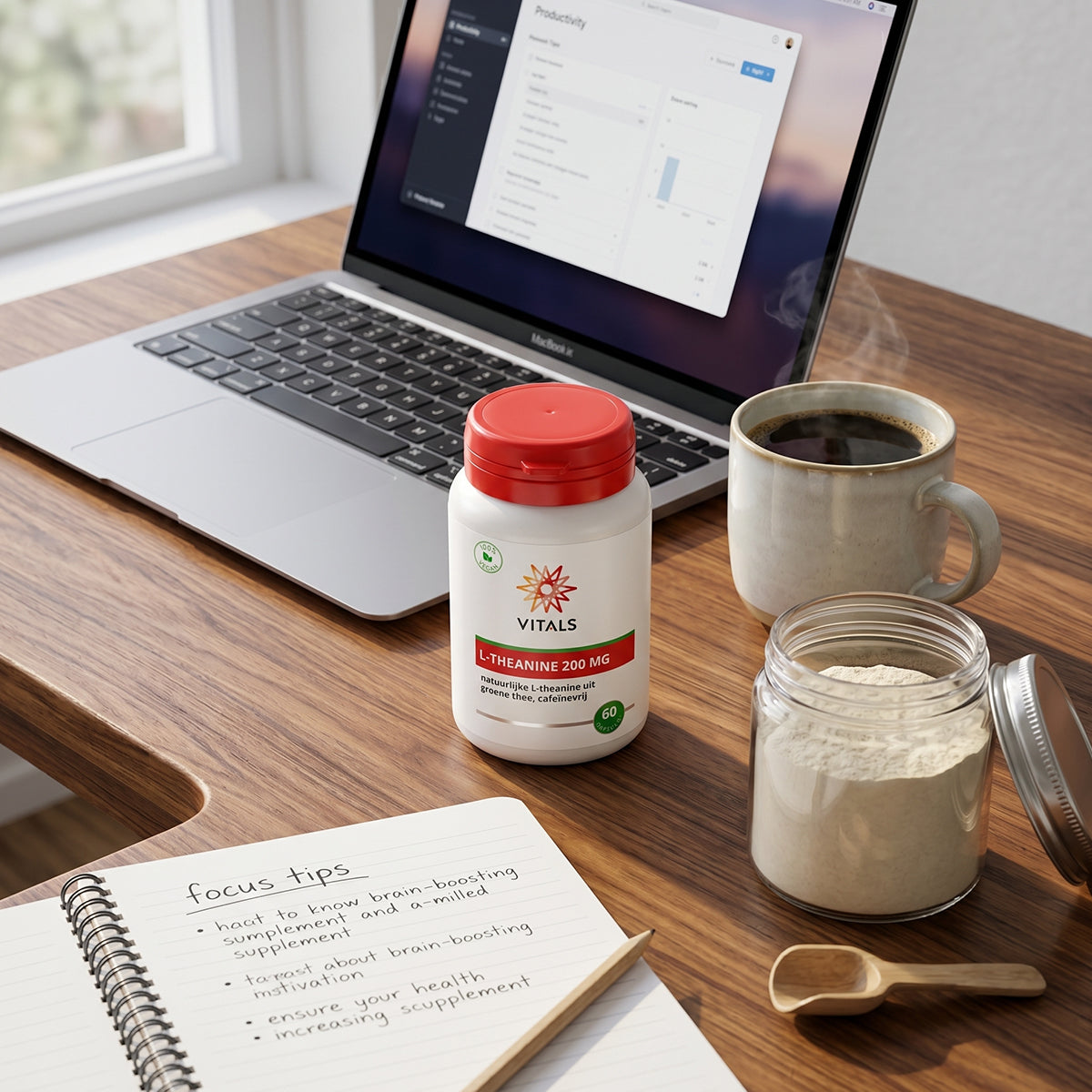
Focus stacks 1 to 3: from classic to B vitamins
Stack #1: L-theanine and caffeine
By far the most discussed and best-used focus stack is the combination of L-theanine(an amino acid from green tea) and caffeine (from coffee or green tea). This combination is used by knowledge workers and students worldwide. There is no recognized EFSA health claim for L-theanine.
How does the combination work?
Caffeine blocks adenosine receptors in the brain — which creates a more alert feeling, but for some people, it also causes side effects such as heart palpitations and restlessness. L-theanine is an amino acid often used in combination with caffeine. There are no recognized EFSA health claims for L-theanine.
Dosage ratio
A frequently used ratio is 2:1 L-theanine:caffeine — for example, 200 mg L-theanine + 100 mg caffeine (approximately one cup of coffee). For those sensitive to caffeine: 200 mg L-theanine with 50 mg caffeine is also common.
Stack #2: Lion's Mane + L-theanine + omega-3
For those who want to combine focus with long-term cognitive support:
- Lion's Mane — a mushroom often mentioned in this context; there is no recognized EFSA health claim for Lion's Mane.
- L-theanine - often combined with caffeine during work periods.
- Omega-3 (DHA) — DHA contributes to the maintenance of normal brain function (at 250 mg per day).
These three ingredients are often discussed on different time scales: omega-3 as a long-term base, Lion's Mane over weeks to months, and L-theanine + caffeine as a direct component during work periods. There are no recognized EFSA health claims for L-theanine and Lion's Mane.
Stack #3: B-vitamins + magnesium for stress + focus
For focus challenges related to stress and mental exhaustion (e.g., during a busy work period), a combination of B-vitamins and magnesium is often more effective than focus supplements alone:
- B-vitamins contribute to normal energy-yielding metabolism and normal functioning of the nervous system (see PlantforceVegan B-Complex, private label).
- Magnesium bisglycinate with taurine — magnesium contributes to the normal functioning of the nervous system and normal psychological function (see Vitals magnesium 100 mg with Taurine).
- Optionally B12 separately in case of suspected deficiency.
Focus stacks 4 and 5: adaptogens and 50+
For those expecting peak loads for a season (deadlines, exams, intensive project phase), people often mention an adaptogenic base with a Cognitive Blend:
- Ashwagandha-KSMor a Cognitive Blend (KiKi Health) — often discussed in this context; there are no recognized EFSA health claims for these ingredients.
- Lion's Mane -often mentioned in this context (no recognized EFSA health claim).
- L-theanine -used occasionally.
Stack #5: Cerebral blood flow for 50+
For the 50+ target group where cerebral blood flow plays a role (memory, concentration):
- Ginkgo biloba (Doctor's Best Extra Strength Ginkgo) —often mentioned in the 50+ target group; there is no recognized EFSA health claim for Ginkgo.
- Omega-3 (DHA) —DHA contributes to the maintenance of normal brain function (at 250 mg per day).
- Q10(Doctor's Best Ubiquinol)— in people 50+, the body's own Q10 production decreases. There is no recognized EFSA health claim for Q10.
Frequently asked questions about focus stacks
How long does L-theanine + caffeine work?
How long does L-theanine + caffeine work?
The effect of L-theanine occurs within 30-60 minutes and lasts 2-4 hours. The caffeine component works for 4-6 hours, depending on the person and dosage. Many people schedule L-theanine + caffeine in the morning and possibly around noon — no later than 2 PM to avoid affecting sleep.
Can I use a focus stack daily or is it better to use it cyclically?
Can I use a focus stack daily or is it better to use it cyclically?
L-theanine + caffeine can be taken daily. Adaptogens are used cyclically by some (e.g., 8 weeks on, 2-4 weeks off). Lion's Mane and omega-3 are suitable for long-term use. Ginkgo: often in periods of 8-12 weeks.
May I combine a focus stack with stimulant medication?
May I combine a focus stack with stimulant medication?
When using stimulant medication: always consult with the prescribing physician before adding a focus stack. Some combinations (especially stimulant-caffeine) can interact.
Which stack is suitable for studying for exams?
Which stack is suitable for studying for exams?
For an exam period (3-6 weeks of intensive preparation), people often mention combinations of Lion's Mane (Aug #1), L-theanine + caffeine during study sessions, a B-complex (B vitamins contribute to normal energy-yielding metabolism), and ashwagandha. There are no recognized EFSA health claims for Lion's Mane, L-theanine, and ashwagandha. Don't forget: sufficient sleep remains the most critical factor for learning ability.
Can I use a Cognitive Blend instead of a separate stack?
Can I use a Cognitive Blend instead of a separate stack?
Yes — KiKi Health Cognitive Blend, for example, combines nootropics and adaptogens in one formula. Advantage: convenience and good value for money. Disadvantage: less control over individual components. For those who want to experiment: a separate approach. For those who want convenience: a blend.
Building a focus stack yourself (and what to avoid)
Build your own stack
Step 1 — Define your profile
Start by asking yourself: what is my primary challenge? Acute focus for work sessions? Long-term cognitive enhancement? Stress + mental exhaustion? Support for normal brain function (50+)? The answer determines which stack building blocks are relevant for you.
Step 2 — Start with one element and build up
Starting three new supplements simultaneously makes evaluation difficult. Begin with one (e.g., L-theanine + caffeine), evaluate for 2-4 weeks, then add a second element. This way, you'll know what works—and what doesn't work for you.
Step 3 — Give it time
Different ingredients are discussed on different timescales: some (L-theanine, caffeine) in the short term, others (Lion's Mane, adaptogens) over weeks, and omega-3 over months. Align your expectations with the timescale of what you're using.
Step 4 — Combine with lifestyle basics
No supplement structurally compensates for poor sleep, lack of exercise, or chronic nutrient deficiencies. A focus stack works best on top of a healthy foundation: 7-9 hours of sleep, regular exercise, sufficient water, regular meals, and stress management.
What to avoid
A few common pitfalls we often see:
- Starting too much at once — makes it impossible to see what works.
- Too high caffeine dosage — more than 400 mg per day (= 4 cups of coffee) is counterproductive for most people.
- Stopping after 1 week — most cognitive effects take weeks to build up.
- Stack without a goal — buying supplements "just because" without a clear question is usually not effective.
- Ignoring sleep — even the best focus stack won't outweigh the impact of structurally poor sleep.
A focus stack is not a miracle formula, but a way to consciously approach combinations of supplements. The classic (L-theanine + caffeine) is a familiar start for many people; from there, you add components that suit your situation — such as Lion's Mane, adaptogens, omega-3 (DHA contributes to the maintenance of normal brain function) or Ginkgo. For several of these ingredients, there are no recognized EFSA health claims. Give each component time, and don't forget: sleep, exercise, and nutrition are the foundation. Supplements are a complement — they do not replace.
Disclaimer: This article is for informational purposes only and does not replace medical advice. A dietary supplement is not a substitute for a varied and balanced diet and a healthy lifestyle. If in doubt or taking medication: consult a doctor or pharmacist. Do not exceed the recommended daily dose. Keep out of reach of young children.
Populaire Producten
Maca Powder – Organic Gelatinized – 100 g
Choose your option
L-Theanine 200 mg – from green tea – 60 Vegan Caps
Choose your option
Doctor’s Best L-Theanine – Suntheanine® – 150 mg – 90 vegetarian capsules
Choose your option
Rhodiola-LF – Rhodiolife® extract – 60 Vegan Caps
Choose your option
Ashwagandha-KSM Organic - 60 capsules
Choose your option
Choose your option
Extra Strong Ginkgo - 360 V-Caps
Choose your option
Choose your option
AHCC® 500mg - 60 caps
Choose your option


